
Turn a conversation into a working brief
Explore an idea in ChatGPT or Claude, save the requirements and decision rationale, then ask Codex to retrieve them before creating a document, tool, or prototype.
Shared memory and context for Codex. Carry research, requirements, and decisions from ChatGPT or Claude into your next Codex task with Angareion.
Dedicated Connect guide · plugin or remote MCP

The direct answer
Angareion gives Codex access to retained knowledge, decisions, outputs, and handoffs through its plugin or a remote MCP connection. A connected Codex task can retrieve context saved by another supported client and preserve what it learns for the next session.
Understand shared AI memoryBuilt around your work
Your project starts before the first file changes. Give Codex the reasoning behind the work: the audience, the constraints, the decision you already made, and what still needs an answer.
Explore an idea in ChatGPT or Claude, save the requirements and decision rationale, then ask Codex to retrieve them before creating a document, tool, or prototype.
Save the constraints and tradeoffs that explain your project. A future task can retrieve why an approach was chosen instead of reconstructing it from scattered conversations.
Retain the result as an output and save a handoff with the remaining work. Return to Claude or ChatGPT to review the outcome against the original brief.
Inside Angareion
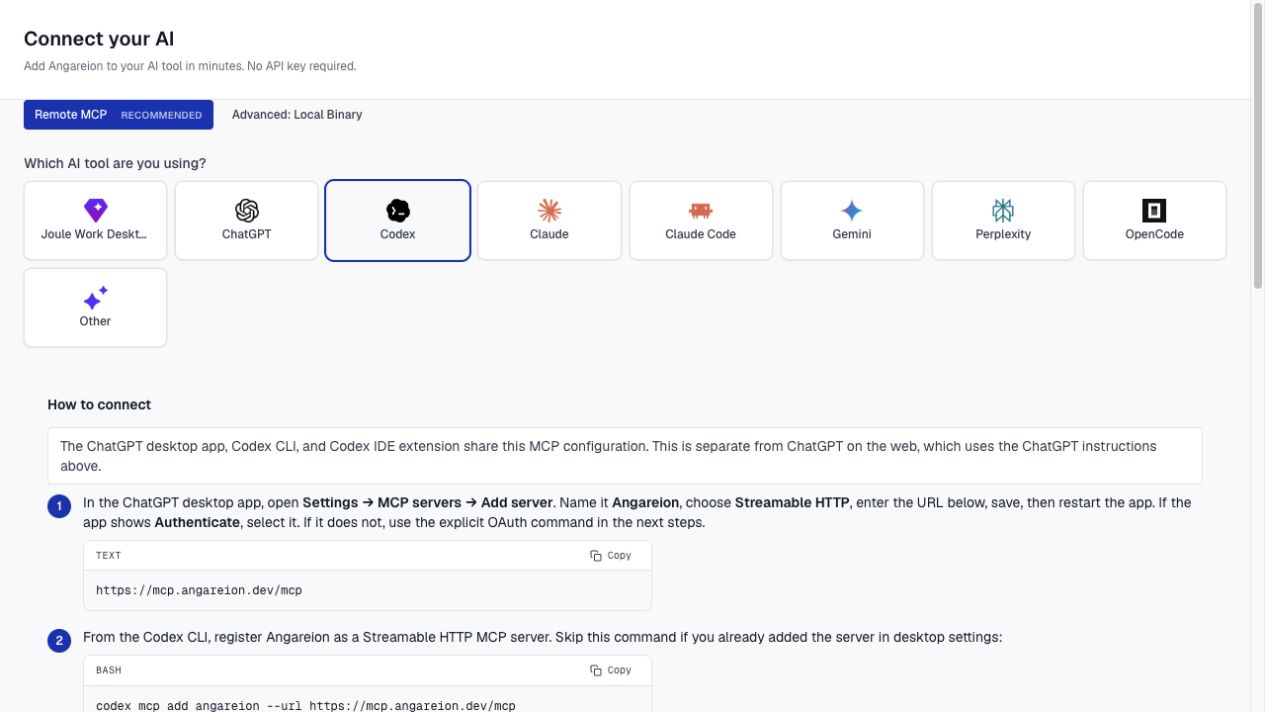
The Connect guide walks you through your client’s setup. Choose the appropriate connection, approve access, and verify the tools before asking for your context.
Your work can travel
Save what matters, then ask another connected assistant to pick it up. The same agent or an authorized shared scope keeps the context available.
“Save the requirements we agreed in Angareion. Include the audience, success criteria, and constraints, and prepare a handoff for Claude.”
Saved in Angareion“Resume the Codex handoff. Retrieve the original requirements and review the result against the success criteria.”
Illustrative prompts. Your assistant must call the connected tools; chat history and local files are not automatically transferred.
How an AI handoff worksMake the connection
Request private-beta access. Open Connect after your account is available and choose Codex.
Install the Angareion Codex plugin from the matching signed release, or configure the remote MCP server and authenticate with codex mcp login angareion. Avoid adding the same server through both paths.
Start a new Codex task and ask Angareion to retrieve your project context or resume a saved handoff. Standalone skills are available for an already configured manual MCP connection.
Questions, answered
What carries over, what needs connecting, and how to keep the work moving.
Explore the knowledge libraryYes. Connect Codex to the same Angareion agent, or use a shared scope it is authorized to read. Ask it to retrieve the brief or resume a handoff. The source client must first save the relevant context to Angareion.
Yes, when those models are available to your account and can use the connected tools. Angareion retains memory separately from the model selected for a Codex task. A task with the configured tools and the appropriate permissions can retrieve that memory. Different models may interpret or use the retrieved context differently.
The shared-memory workflows also apply to research, writing, analysis, and project planning. Ask Codex to retrieve a brief, retain a work product, or save a handoff. The connection guide offers a plugin path as well as a manual CLI setup.
Use the Angareion plugin when you want its reusable workflows and MCP connection packaged together. If you already configured and authenticated the server manually, keep that connection and add standalone skills if needed. Do not duplicate the same server.
Retain useful facts and decisions as memories, add reference material to knowledge sources, save complete work products as outputs, and preserve unfinished work as handoffs. These are explicit workflows: Angareion does not automatically record everything you do in every assistant.
Access follows your Angareion agent identity and permitted memory scopes. Reusing the same agent across clients provides continuity; team or institutional sharing requires the appropriate scope and permissions. Connecting a new client does not give it unrestricted access to every memory.
Request Angareion private-beta access, then follow the connection guide for your client. Angareion does not supply the AI client’s subscription or change its account requirements. Compare the current Angareion editions and check the client’s own eligibility before connecting.
Keep what you learn
Request Angareion access, connect Codex, and build a body of knowledge that can travel with your work.
Private beta. Access is granted from a waitlist.