
A writing partner with the brief in reach
Save your audience, editorial standards, and terminology. Ask Claude to retrieve them before drafting, so you can spend the conversation on the work itself.
Shared memory for Claude. Keep research, decisions, and working preferences available across conversations and connected clients with Angareion.
Claude web and desktop · remote connector

The direct answer
Angareion connects Claude on the web and desktop to shared memory and knowledge through a remote MCP connector. Claude can retrieve saved decisions and source material, retain useful work, and prepare handoffs for ChatGPT, Codex, Gemini, or another authorized client.
Understand shared AI memoryBuilt around your work
A thoughtful answer deserves a longer life than one conversation. Keep the sources, the decisions, and the way you like to work available when you return to Claude or move the project elsewhere.
Save your audience, editorial standards, and terminology. Ask Claude to retrieve them before drafting, so you can spend the conversation on the work itself.
Add useful reference material to Angareion and ask Claude to retrieve the relevant context. Keep the important conclusions and source references for the next question.
Develop a proposal or specification in Claude, then save a handoff for Codex or Claude Code. Preserve the objectives, choices, and blockers that the next session needs.
Inside Angareion
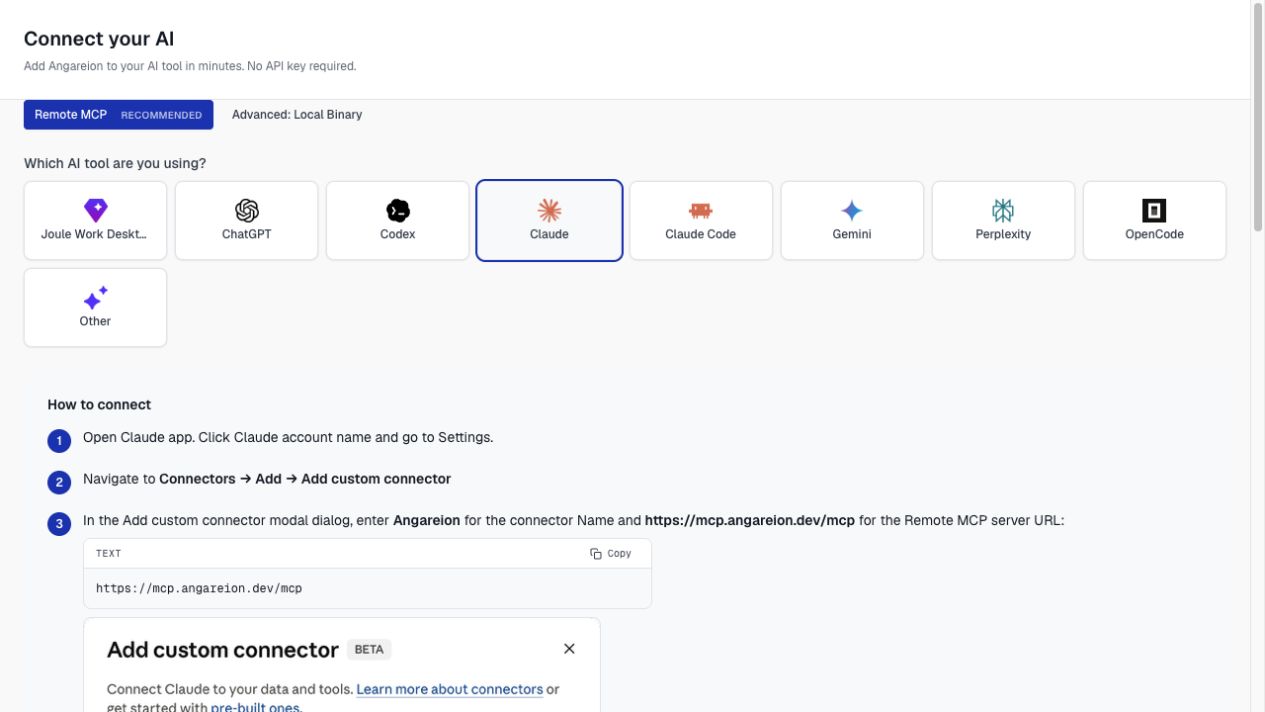
The Connect guide walks you through your client’s setup. Choose the appropriate connection, approve access, and verify the tools before asking for your context.
Your work can travel
Save what matters, then ask another connected assistant to pick it up. The same agent or an authorized shared scope keeps the context available.
“Save our approved brief and the reasons for these decisions in Angareion. Prepare a handoff for Codex, including the next steps and blockers.”
Saved in Angareion“Resume the handoff from Claude. Retrieve the approved brief and help me turn the next steps into a working prototype.”
Illustrative prompts. Your assistant must call the connected tools; chat history and local files are not automatically transferred.
How an AI handoff worksMake the connection
Create your Angareion account when your waitlist invitation arrives. Open Connect and select Claude.
In Claude’s connector settings, add Angareion with the MCP server URL from the guide. Connect it and approve the browser sign-in flow.
Start with a project question. Add the Claude skill pack if you want reusable memory, knowledge, handoff, specialist, and output workflows.
Questions, answered
What carries over, what needs connecting, and how to keep the work moving.
Explore the knowledge libraryWith Angareion connected, ask Claude to save the project facts and decisions you want to keep, then retrieve them in a new conversation. The retained context stays in Angareion and can also be accessed by other clients with the right permissions.
Yes, when the chosen Claude model can use your configured connector. Angareion memory is associated with the authorized agent, not a Sonnet or Opus session. Switching models does not move or delete that memory.
The same principle applies: the client must expose the Angareion tools to that model. Tool availability and account access are controlled by Claude. Angareion supplies the retained context; the selected model decides how to reason with it.
Save the relevant knowledge, output, or handoff to Angareion. Connect the other client to the same agent or an authorized shared scope, then ask it to retrieve that work. This shares retained context rather than automatically copying every Claude conversation.
Retain useful facts and decisions as memories, add reference material to knowledge sources, save complete work products as outputs, and preserve unfinished work as handoffs. These are explicit workflows: Angareion does not automatically record everything you do in every assistant.
Access follows your Angareion agent identity and permitted memory scopes. Reusing the same agent across clients provides continuity; team or institutional sharing requires the appropriate scope and permissions. Connecting a new client does not give it unrestricted access to every memory.
Request Angareion private-beta access, then follow the connection guide for your client. Angareion does not supply the AI client’s subscription or change its account requirements. Compare the current Angareion editions and check the client’s own eligibility before connecting.
Keep what you learn
Request Angareion access, connect Claude, and build a body of knowledge that can travel with your work.
Private beta. Access is granted from a waitlist.